


Fictions of Friction
By Catherine Borthwick

Anna Kornbluh’s Immediacy: Or, the Style of Too Late Capitalism (January '24) roots itself in the contemporary notion that aesthetic mediation is rapidly dissolving. The instantaneity of media and consumable goods — streaming television, social media platforms, same-day delivery, and so on — are all symptomatic of greater social and economic underpinnings, those of “disintermediation.” To have everything constantly available is to bypass styledness for expedience, friction for rapid flow.
A striking sensibility of Immediacy is Kornbluh’s fearlessness in traversing mediums at high velocity. NFTs, advertisement slogans, Van Gogh-inspired yoga, and contemporary television all appear within the first few pages of the introduction. (“Kornbluh’s book is flooded with lists,” Grace Byron dryly remarks for the LARB). Yet it would be difficult not to analyse each of these separate mediums when, as Kornbluh argues, they are all part of a greater pattern, in part owing to their ubiquity.
When prompted about the vast territory her book endeavors to cover (literature, philosophy, contemporary art, film, television, and economics all being points of discussion) Kornbluh says that while writing the book was difficult, it was also what made structuring it a particularly interesting exercise.
“Some of the fun is that I do have a tradition to draw upon, which is the tradition of Marxist aesthetic interpretation,” Kornbluh says, referencing Frederick Jameson amongst other influential Marxist academics. “You're always trying to think about what the relationship is between aesthetic representation, artistic innovation and cultural styles, and the kind of base of the economic, social and political relations.”
The prose employs a mix of what Kornbluh identifies as Germanic, philosophical-style sentences and “theory-speak:” language that “counters the immersive fluid aesthetic as is the sort of syntactical structure.” Kornbluh tells me that she tried to make the language difficult in places and even slightly counterintuitive, with varied rhythms, so that the reader couldn't have a completely seamless, easy uptake. This is one of many examples where the form of the book facilitates its function.
I am unashamed to admit that as I read, I held the paperback in one hand and the Oxford English dictionary in the other (online, and therefore immediate) . Kornbluh’s affinity for unusual jargon reads as simultaneously uniquely esoteric and stimulating to those of us aesthetic philistines who have the patience to look up several words per page. As I read, I wondered how much wording might be a side-effect of the narrow and definitive inquiries of an academic deep in research. Did the book entertain verbosity for its own sake? But, in conversation, I appreciated how cohesive and eloquent Kornbluh was as she strung similar theoretical and aesthetically critical phrases together, leading me with an intellectual nimbleness from imminentism to Marxist cultural interpretation to technological politics back into her thesis of contemporary cultural style.
When I ask about the genesis of Immediacy, Kornbluh points to literature. “I teach a lot of 18th and 19th century fiction,” she tells me, “But I read a lot of contemporary fiction for fun, and I had noticed very painfully and acutely across the 21st century, but especially the 2010s, that you just simply couldn't go to the bookstore and buy a new novel that was in the third person.” This phenomenon is strange to Kornbluh, “because this is not what the novel is.”
So what is the novel? In Immediacy, Kornbluh argues that third-person narration defines the novel because it represents an extraordinary construction of a mode of thought unavailable to us in everyday experience, in our own stupid envelopes. Third person stretches away from phenomenal subjectivity, towards speculative objectivity. It enacts a kind of thinking unavailable anywhere else — and that’s the magic (79).
In her book, the systematisation of this phenomenon comes in the form of computational cultural criticism, or literally mapping out usage of the third-person in literature throughout the decades. In the graph, we see a spike in the dominance of the first-person at the turn of the twenty-first century.
“This is a radical change that demands explanation,” Kornbluh says. “When an art form emerges like the novel, and has a 300 year way of being, and then it suddenly changes in the Anglo tradition -- what accounts for that change? That's really the question I started with, but because that causal explanation would sort of work for other cultural forms, too. I wanted to figure out if it was specific to the novel or if it was happening in its own way in other media.”
Kornbluh’s later discussion of autofiction and autotheory, which critically examines the likes of Andrea Long Chu and Maggie Nelson, speaks to the ever-present “I” at the center of autofiction, as well as the modern novel, which indicates literary solipsism to Kornbluh. The memoir too, which the New York Times identifies as “the dominant genre of contemporary literature,” is an example of “literary immediacy’s antifictional exudiation” in Kornbluh’s chapter entitled “Writing.” Memoirs dominate the publishing marketplace (Googling “highest book deals” yields almost entirely memories and almost no fiction titles). Direct testimonies, first-person accounts, and personalist narratives are valued, and bleed into fiction. What is memoir if not imminent and immediate?
Ultimately, these trends in contemporary literature are, to Kornbluh, the canary in the coal mine, and apply to a multitude of other media. Kornbluh and I speak about the overhaul in how we consume television: how it is produced for the streaming platform. “This affects the content and the shape of television into something like streaming style, which is different from what it was on network TV and even prestige TV,” Kornbluh says. “And is that difference in any way logically, informally and aesthetically comparable to this personalization of the novel, and this evacuation of fictionality in the novel, and this repudiation of temporal duration in the novel?” The book answers in the affirmative.
Though the project was borne from print books, it is clear that it would be impossible to discuss any of the aesthetic content in question without either directly or indirectly addressing technology. Walter Benjamin’s seminal essay “The Work of Art in the Age of Mechanical Reproduction” (1935) examines the effect of technological advances (for instance, photography) on the aura of a painting. Nearly a century later, we can, ostensibly, infinitely reproduce at maximum speed. Thus, Kornbluh asks related questions about the “pressures against mediation” when instantaneity is the norm.
The LARB claims that “in the classical sense, Kornbluh is a Luddite.” But Kornbluh tells me she isn’t anti-technology, social media, or innovation. “I am concerned that we are in a position that is mostly about economic stagnation and the way that technology gets fetishized in this moment, and the way that our overlords keep trying to promise that technology is going to deliver us out of the kind of capacity tract that we're in, in terms of the incorporation of human labor into a global market, workplace, and in terms of the ability of that incorporation, to provide infinite profit or not,” she tells me.
In simpler terms, Kornbluh is critical of technology that is driven by the capitalist cultural and economic conditions that she describes throughout the book. But does this amount to a condemnation of technology as a whole? No. Instead, she asks us to consider its effect on mediation, which is a concept that she ultimately praises. “Mediations are composites of language, composites of images, compositions of meaning, composed ideas,” Kornbluh writes in her conclusion, “that produce something more than immediate experience.” She urges us to look mediation in the eye rather than lose it to the instantaneity driven by contemporary consumer culture. Don’t evacuate mediation, says Kornbluh in Immediacy: activate it. It’s not too late.
CATHERINE BORTHWICK lives in an attic.
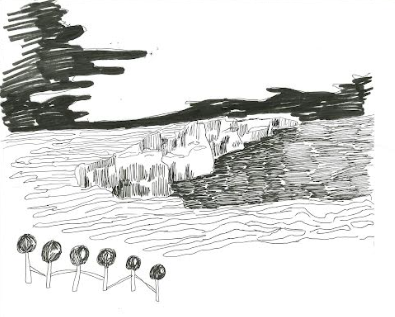
Art by Cordelia Wilson


Nature thrives on constructive resistance—just look at how epiphytes like dendrobium nobile depend on rough bark and environmental friction to anchor and bloom. Essential read!
I appreciate the depth of research and clarity in your writing. This piece provides a fresh and compelling take on the subject. bound by insanity
Check out our latest guide for some awesome tips to help you level up your site today. We hope you find these strategies super helpful.
Good aim is obviously important in build now gg, but accuracy alone will not guarantee victory. Players need to understand movement, positioning, timing, and enemy behavior.
Thank you for sharing this detailed guide. The Samagra ID Download process was explained very clearly and was easy to follow.